

Weekdays: 8 AM – 4 PM

Posts by ddemartini

Best Practices - Geogrid

BEST PRACTICES – GEOGRID REINFORCEMENT

The National Concrete Masonry Association (NCMA) has put together a collection of  practical, field proven solutions.  This excerpt is for best practices when using geogrid reinforcement. 

Reinforcement Empirical Limits:

  • Minimum grid length =
    • 60% H static,
    • 60% bottom/middle and
    • 90% upper layers for seismic
  • Absolute minimum grid length = 4.00 feet
  • Minimum anchorage length (beyond failure plane) = 1 foot
  • Maximum vertical spacing =
    • 16 inches if % passing #200 is >35%
    • 24 inches if % passing #200 is <35%
  • Maximum vertical spacing = twice (2x) the block depth
  • Minimum soil cover between layers = 3 inches
  • Maximum height to first layer of geogrid = 18 inches

    For more information on best practices for segmental retaining walls, download the NCMA guide here.
    Read more

    PDEAS, SOIL NAILS & HELICAL ANCHORS…OH MY!

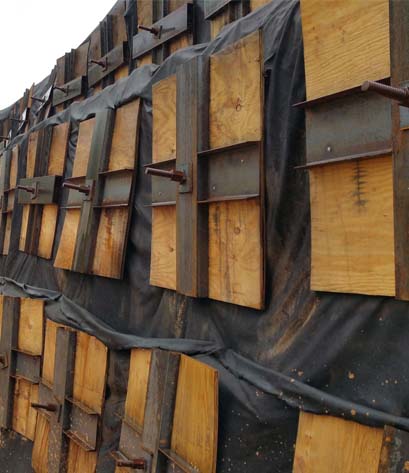
    Earth anchors are often used in earth retention designs when geogrid reinforcement is not an option.  But these amazing earth retention solutions come in a variety of shapes and sizes and  it can be overwhelming or intimidating to determine which option is best for your project.  Let us help you down the yellow brick road to success by breaking down the differences between some of the most common earth anchor options available.  Learn more about Percussion Driven Earth Anchors (PDEAs), Soil Nails and Helical Anchors—how they work, their benefits and challenges here:

    Percussion Driven Earth Anchors (PDEAs)

    What are they:  Metal rod with a mechanical anchoring system at one end to tie back or stabilize the ground for vertical construction in either temporary or permanent structures. (Examples: Duckbill, Manta Ray, Platypus.)

    How it Works:  A PDEA is impact driven by hammering a driving to force the anchor end and rod/cable into the ground.  Once the determined anchoring depth is reached, the rod/cable is pulled back on from the ground surface to engage and rotate the anchor head, commonly referred to as “anchor locked”.  The load required to pull and lock the anchor is monitored with a device called a load locker which is monitored for capacity and is stopped when the anchor has reached the required design capacity.  A bearing plate is then secured to the end of the anchor and distributes the surface load to suffice pullout requirements.

    When to use: Erosion Control to anchor different types of geosynthetic & metallic mats and meshes, Retaining Walls, Tree & Pole Anchoring, Landfill Capping, Hurricane Proofing, Slope stabilization, temporary structures and other construction techniques.

    Benefits: Often times, the least expensive of all systems and several of them on the market.  Fast/easy to install and corrosion resistant.

    Challenges: Least reliable of all systems as soils in the anchoring zone may be uncertain or undefined and anticipated design loads may not be attained.  Often not allowed on DOT projects for permanent structures.

    Soil Nails

    What are they: There are two different types of soil nails:

    1. Hollow steel rod with tube inside to that allows grout injection for full length of “nail”.
    2. Solid bar or strand used in open hole installation which is the grout injected to create the nail bonded to the adjacent soil stratum.

    How it Works:  A hole is drilled or rod pushed into the earth at engineered depths and locations.  The soil nail is inserted into the hole.  Grout is pumped into the tube and the rod is slowly retracted as grout fills the hole behind it leaving a “bulb” at the base of the rod and along its sides to act as a nail, securing soil around it.  A plate is then fastened to the end of the nail.

    When to use: Erosion Control to anchor different types of geosynthetic & metallic mats and meshes, Tunnels, & Retaining Walls, Slope stabilization, temporary structures and other construction techniques.

    Benefits: Very reliable system in engineering terms.  Accepted by agencies such as DOT’s, FHWA, and AASHTO.  Can be done in more confined sites where there are property line or construction easement limitations.  Process is fast and there is no height limitation.

    Challenges: Cost can be comparable to Helical Anchors.  Can’t be used in water applications or where ground water is a concern.  Need specialized contactor to install.  Plates and nails can be corrosive, but non-corrosive options are available as well.

    Helical Anchors

    What are they: Also known as screw anchors or screw piers/piles.  Metal tube anchoring systems that is “screwed” into the ground.

    How it Works:  Helical anchors are twisted into the ground using hydraulic rotary equipment that can place the anchor very deep below the ground surface.  The anchor is installed in sections that allows variation in flight sizes with increasing width nearer to the surface to achieve the engineered capacity requirements.  Since the anchors are hollow, they can be filled with grout to increases their frictional capacity.

    When to use: If surficial foundation conditions cannot support the load of the intended structure, especially when alternate construction techniques are not feasible for cost or schedule.  Used to repair an existing structure’s foundation that has sustained damage without need for large excavations.

    Benefits: Most reliable of all systems in engineering terms.  Several feet can be drilled in a very short amount of time.  Increases bearing of poor or loose with minimal environmental impact.  Can be used to resist vertical uplift forces such as those created by permafrost. 

    Challenges: Commonly most expensive of all systems.  Cannot be used in dense/rocky soil types.  Need specialized contactor to install. 

    Read more
    best practices MSE wall backfill

    BEST PRACTICES – MSE WALL BACKFILL RECOMMENDATIONS

    For Walls Up To 10 Feet:

    • Recommended Backfill Types = GW, GP, SW, SP, SM, SC
    • Maximum Atterberg Limits (LL and PI) = PI < 20, LL <40
    • Minimum Compaction = 95% of Standard Proctor Density
    • Moisture Content = +/- 2% of optimum moisture
    • Recommended Material Gradation:
    SIEVE SIZEPERCENT PASSING
    1 in.100
    No. 420-100
    No. 400-60
    No. 2000-35

    For Walls 10 Feet to 20 Feet:

    • Recommended Backfill Types = GW, GP, SW, SP, SM, SC
    • Maximum Atterberg Limits (LL and PI) = PI < 6, LL <40
    • Minimum Compaction = 98% of Standard Proctor Density
    • Moisture Content = +/- 2% of optimum moisture
    • Recommended Material Gradation = Same as walls shorter than 10 – feet

    For Walls Over 20 Feet:

    • Recommended Backfill Types = GW, GP, SW, SP
    • Maximum Atterberg Limits (LL and PI) = PI < 6
    • Minimum Compaction = 98% of Standard Proctor Density
    • Moisture Content = +/- 2% of optimum moisture
    • Recommended Material Gradation:
    SIEVE SIZEPERCENT PASSING
    1 in.100
    No. 420-100
    No. 400-60
    No. 2000-15
    Read more